 how-to
Durable Landscape Design for Hill Country: A How-To Guide
Table of Contents
- Understanding Hill Country Terrain and Climate Challenges
- Step 1: Assess Your Soil and Topography
- Step 2: Select Native Plants for Rocky Soil
- Step 3: Implement Erosion Control Landscaping Techniques
- Step 4: Design Hardscape Elements for Longevity
- Step 5: Integrate Artificial Turf and Permeable Surfaces
- Step 6: Plan Seasonal Maintenance and Fire-Wise Practices
- Frequently Asked Questions
Last Updated: September 23, 2026
Understanding Hill Country Terrain and Climate Challenges
The Hill Country presents unique landscaping obstacles that test most designs within the first year. Rocky limestone soil, intense summer heat, steep slopes, and unpredictable rainfall create conditions where standard approaches fail fast. Durable landscape design for hill country requires understanding these specific challenges before you break ground.
Caliche layers trap water and prevent root penetration. Slopes erode after heavy rains. Heat reflects off limestone, creating microclimates where plants won't survive.
Wolverine Land Services L.L.C. specializes in landscapes that hold up to these conditions, not ones that look good initially then deteriorate.
Most homeowners learn this the hard way: contractors treating Hill Country like standard Texas property result in failed plantings, eroded slopes, and warped fencing. Durable landscape design means building with the terrain, not against it.
Step 1: Assess Your Soil and Topography
Dig several holes across your property at different elevations to assess soil depth, caliche presence, and drainage.
Caliche, a cement-like layer of calcium carbonate, blocks water and roots. Depth determines your options: 6 inches is problematic, 18 inches is manageable, 3 feet is favorable.
Fill a hole with water and time drainage. Fast drainage requires drought-tolerant plants; slow drainage risks root rot. Most Hill Country properties drain extremely fast due to limestone permeability.
Slopes steeper than 3:1 will erode without intervention; gentler slopes may need reinforcement depending on soil type.
| Assessment Point | What to Look For | What It Means |
|---|---|---|
| Caliche depth | How deep before you hit hard layer | Determines root penetration depth |
| Drainage speed | Minutes for water to drain | Tells you plant water needs |
| Slope angle | Ratio of horizontal to vertical | Indicates erosion risk level |
| Limestone outcrops | Natural rock exposure | Affects hardscape placement |
Step 2: Select Native Plants for Rocky Soil
Native plants are essential for durable landscape design in the Hill Country, they've evolved to handle limestone, caliche, heat, and drought.
Choose plants thriving in rocky, alkaline soil with minimal water: agave, yucca, sotol, Texas sage, esperanza, desert marigold, and native grasses like sideoats grama and little bluestem.
Layer your palette: canopy trees (Texas oak, cedar elm) for shade and structure, mid-story shrubs, and groundcovers with native grasses for soil stabilization.
Space plants for mature size, not nursery size. Crowding creates competition and disease; sparse year-one plantings fill in by year three.
Water establishment plantings deeply but infrequently for the first season to encourage deep root growth. After establishment, native plants need minimal supplemental water.
Step 3: Implement Erosion Control Landscaping Techniques
Erosion control landscaping proves durable landscape design. Proper slope management requires a layered approach addressing water velocity, soil stabilization, and vegetation establishment in sequence.
Terracing: Building the Foundation
Terrace slopes steeper than 2:1 using limestone blocks or treated timber. Each terrace catches runoff, prevents water acceleration, and creates usable space.
Use dry-stacked limestone blocks ($3-$8 per sq ft) for walls 2-4 feet tall. Set on 4 inches of compacted soil and backfill with gravel, not soil. Install a perforated 4-inch PVC drain pipe ($0.50-$1.00/linear ft) running the wall length, sloped to daylight. Without drainage, hydrostatic pressure causes failure within 3-5 years.
Space terraces 15-25 feet apart vertically (closer for steeper slopes), at least 6-8 feet wide to prevent water concentration.
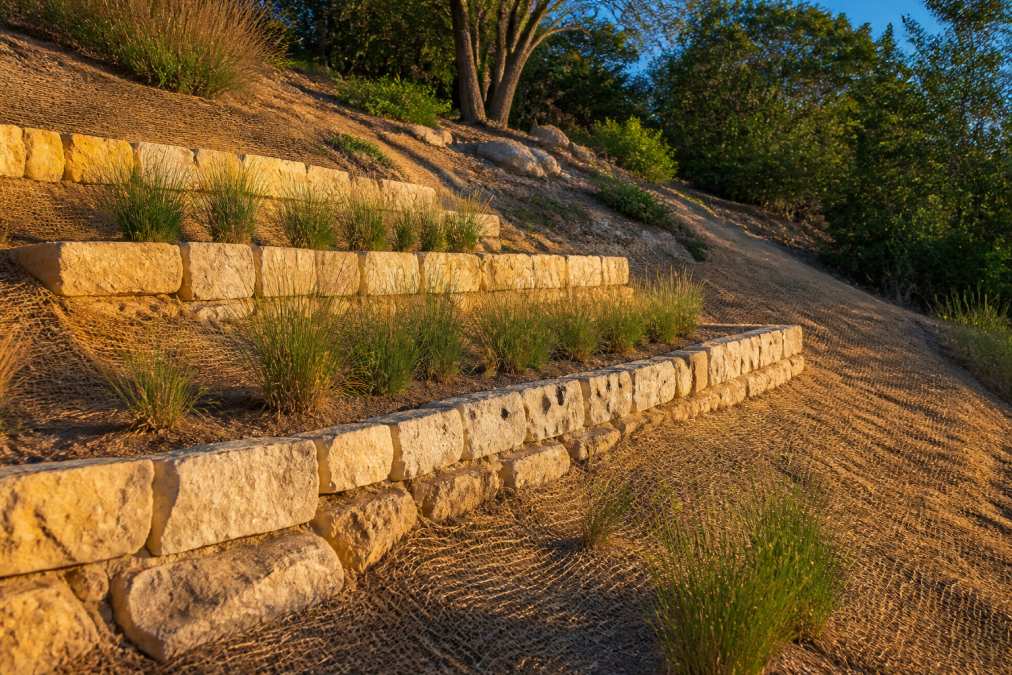
Erosion Control Matting: Immediate Slope Protection
Install coir or jute erosion control matting ($0.75-$1.50/sq yd) immediately after grading. Avoid plastic netting; coir mats biodegrade in 6-12 months.
Anchor mats with stakes 2 feet apart, burying the uphill edge 4-6 inches and overlapping seams by 12 inches. Mats biodegrade in 6-9 months as vegetation establishes.
Check Dams: Breaking Water Velocity
Add check dams (rock berms or log barriers perpendicular to flow) in drainage channels, spaced 15-20 feet apart (closer for steeper slopes).
Build check dams 12-18 inches high from stacked limestone or logs, spanning the full channel width with slight uphill grade. Remove accumulated sediment annually.
Native Grass Planting for Soil Stabilization
Plant native grasses (sideoats grama, little bluestem, buffalograss, blue grama) on slopes and terraces for soil stabilization with minimal maintenance.
Space plants 12-18 inches apart for faster coverage or 18-24 inches to reduce cost. Plant in fall or early spring; avoid summer planting due to heat stress.
Water establishment plantings deeply but infrequently for the first season (once weekly in dry periods). This encourages deep root growth. After establishment, native grasses need minimal supplemental water except during severe drought.
Integration Sequence
Follow this sequence: grade and terrace, install wall drainage, apply matting, plant grasses and shrubs, then install check dams. This prevents interference and ensures plants are established.
Step 4: Design Hardscape Elements for Longevity
Hardscape must be engineered for decades in Hill Country. Material selection determines whether a project lasts 5 or 30 years.
Use limestone and flagstone, native, natural-looking, and freeze-thaw resistant. Avoid soft sandstone or slate. Lueders limestone is particularly durable.
Build retaining walls with perforated drain pipe behind and gravel backfill. Proper drainage doubles wall lifespan.
Place large boulders (200+ pounds) naturally to break water flow and anchor slopes. Group odd numbers for visual balance.
Use permeable surfaces (gravel, decomposed granite, permeable pavers) instead of solid concrete to reduce runoff and erosion.
Step 5: Integrate Artificial Turf and Permeable Surfaces
Artificial turf works in high-traffic areas where natural grass struggles, requiring minimal water.
Choose permeable artificial turf to allow drainage and prevent pooling. Non-permeable turf causes algae growth.
Install over compacted soil with 2-3 inches of permeable base material. Improper installation causes premature wear.
Combine artificial turf with permeable hardscape (decomposed granite, gravel, permeable pavers) to reduce heat island effect and maintain infiltration.
Natural grass requires significant water. If desired, choose drought-tolerant varieties like buffalo grass, accepting summer dormancy.
Step 6: Plan Seasonal Maintenance and Fire-Wise Practices
Maintenance schedules determine whether durable landscape design lasts. In Hill Country, fire-wise landscaping is foundational, shaping plant selection, spacing, and seasonal care.
Fire-Wise Landscape Design Principles
Fire-wise landscaping creates defensible space and reduces fuel load around structures. The concept is based on three zones:
Zone 1 (0-5 feet from structures): This is your immediate defense zone. Remove all dead plant material, fallen branches, and leaves. Use only low-growing, fire-resistant plants like agave, yucca, and sedums. Space plants 10 feet apart (measured from canopy edge to canopy edge) to prevent fire from jumping between plants. No mulch within 5 feet of structures; use gravel or hardscape instead. Keep tree branches 6-10 feet above ground to prevent fire from climbing into canopy.
Zone 2 (5-30 feet from structures): This is your intermediate zone.
Fire-Resistant Plant Selection
Highly fire-resistant plants for Hill Country:
- Agave (all species): Succulent, high moisture content, slow-growing
- Yucca (all species): Succulent, open structure, minimal dead material accumulation
- Sotol: Succulent, open structure, naturally fire-resistant
- Texas sage (Salvia greggii): Low resin, open growth habit
- Desert marigold: Low fuel load, minimal dead material
- Esperanza (Tecoma stans): Open structure, high moisture content
- Native grasses (sideoats grama, little bluestem, buffalograss): Low fuel load when maintained
- Agarito: Open structure, minimal dead material
- Fragrant sumac: Low resin, open growth
Plants to avoid or minimize in fire-wise landscapes:
- Juniper (eastern red cedar): Extremely flammable, high resin content, accumulates dead material
- Cedar: High resin content, flammable
- Privet: Dense growth, accumulates dead material
- Ornamental grasses with dense structure: Can trap dead material
- Heavily mulched areas: Mulch is fuel; use gravel instead
Seasonal Maintenance Calendar
Spring (March-April): Defensible Space Cleanup
Summer (May-August): Heat Stress and Fuel Management
Fall (September-November): Hardening and Fuel Reduction
Winter (December-February): Minimal but Critical Maintenance
Integrating Fire-Wise Practices Into Hardscape Design
Frequently Asked Questions
What makes durable landscape design different for Hill Country properties?
Hill Country terrain combines limestone-heavy soil, steep slopes, extreme heat, and high humidity, conditions that quickly degrade standard landscaping. Durable landscape design accounts for these factors by using erosion control techniques, native plants adapted to rocky soil, and hardscape materials like limestone and flagstone that withstand temperature swings and moisture cycling. Properties designed this way require less frequent replacement and maintenance.
How do I prevent soil erosion on a sloped lot?
Start with erosion control landscaping techniques: install terracing or retaining walls to break the slope into manageable sections, plant native grasses and groundcovers with deep root systems to stabilize soil, and use erosion control matting on bare slopes during establishment. Direct water flow away from the slope using swales or permeable surfaces, and avoid disturbing the soil more than necessary. These steps work together to reduce runoff and hold soil in place during heavy rain.
What are the best native plants for rocky Hill Country soil?
Native plants for rocky soil include Texas sage, mountain laurel, Texas privet, and native grasses like sideoats grama and little bluestem. Succulents such as agave and hardy sedums thrive in limestone-based soil with minimal amendment. These species require less water, tolerate heat, and develop root systems that work in shallow, rocky soil. They also support local wildlife and require fewer inputs than non-native plants, making them ideal for water-wise, sustainable design.
Is commercial fake grass a good option for Hill Country landscaping?
Commercial fake grass works well in Hill Country if installed correctly over permeable surfaces and proper drainage infrastructure. It eliminates irrigation needs, handles extreme heat without browning, and reduces maintenance. However, quality matters, choose products rated for UV resistance and heat durability. Ensure drainage systems prevent water pooling, which can damage the base. For most Hill Country properties, a mix of artificial turf in high-traffic areas and native plantings elsewhere balances durability with landscape character.